When estrogen treatment begins may matter—but the outcome being measured matters just as much. In ELITE, 643 healthy postmenopausal women were randomized to oral estradiol or placebo within two groups defined by years since menopause. After a median of five years, estradiol slowed progression of a carotid artery wall measurement in the earlier-menopause group. It did not significantly change the coronary artery measures assessed by cardiac CT in either timing group.
That is meaningful evidence about an arterial imaging endpoint, not proof that starting estrogen soon after menopause prevents heart attacks. Understanding the distinction requires separating the estrogen molecule, administration route, progesterone regimen, uterine status, and outcome. This analysis uses the indexed primary report abstract, the indexed WHI breast-outcomes abstract, and available official prescribing and FDA material; it does not represent a review of the trials’ full protocols or supplements.
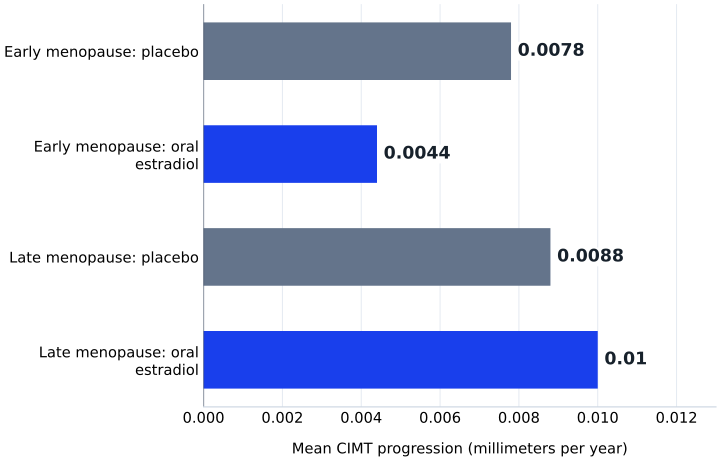
ELITE randomized 643 healthy postmenopausal women within strata of less than six years or at least 10 years since menopause.
Study facts at a glance
Population and randomization: ELITE randomized 643 healthy postmenopausal women within strata of less than six years or at least 10 years since menopause. Source 1
Studied regimen: The active arm used oral 17β-estradiol, with sequential vaginal progesterone gel for participants with a uterus—not an estradiol patch or a combined oral capsule. Source 1
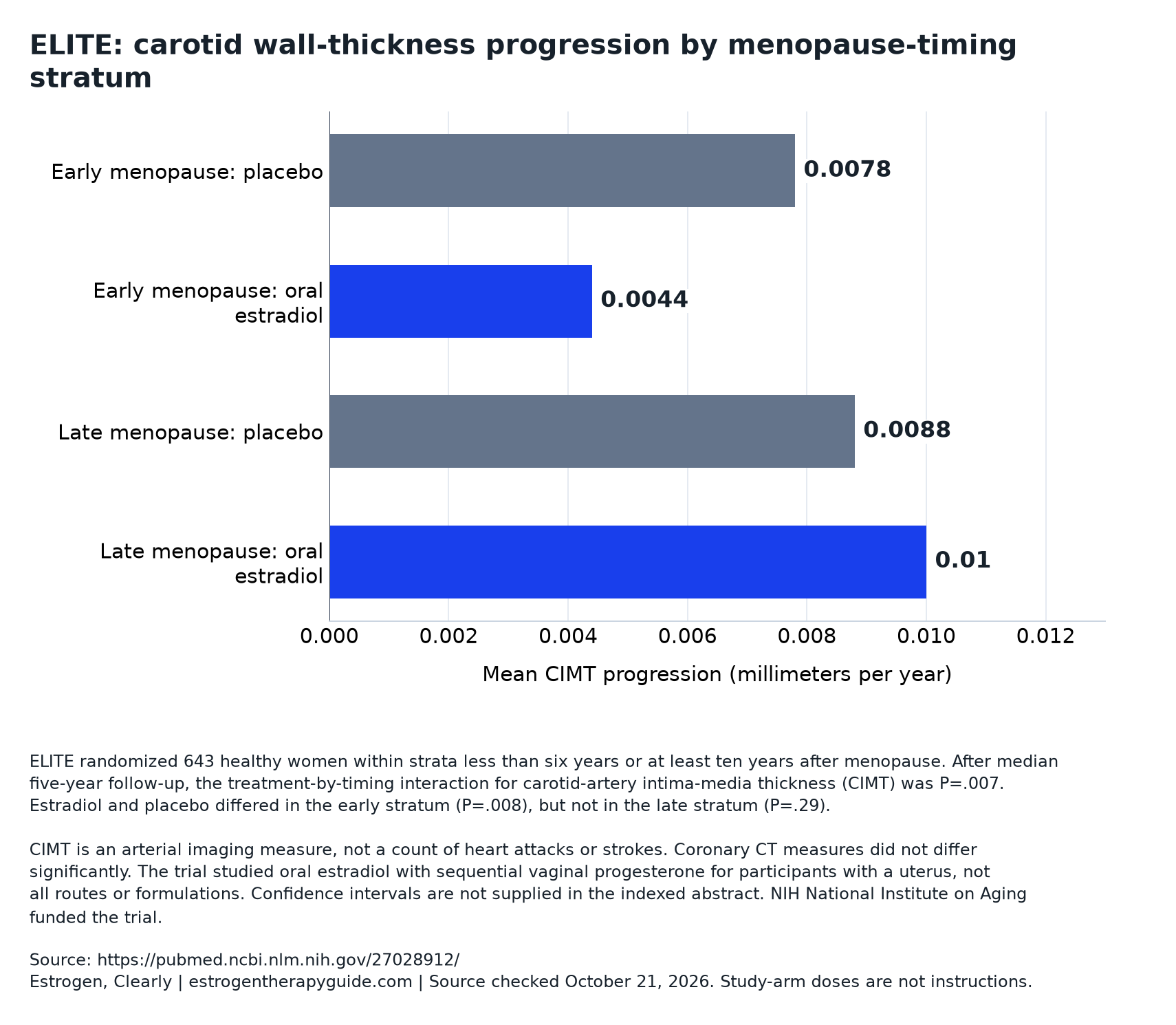
Earlier-menopause result: Carotid intima-media thickness increased by 0.0078 mm/year with placebo versus 0.0044 mm/year with estradiol, an absolute difference of 0.0034 mm/year. Source 1
Timing interaction: Treatment effects on carotid thickening differed between timing strata, with an interaction P value of 0.007; the later group had no statistically significant treatment difference. Source 1
Clinical and regulatory boundary: ELITE did not establish cardiovascular prevention. Current BIJUVA labeling separately states that its safety and efficacy for cardiovascular prevention have not been established, despite removal of its boxed warning in 2026. Source 1 Source 3 Source 4
The experiment tested treatment within timing groups
ELITE addressed the hormone-timing hypothesis: whether vascular effects of menopausal hormone treatment differ when treatment begins relatively close to menopause rather than much later. Investigators first classified participants as less than six years since menopause or at least 10 years since menopause. They then randomly assigned treatment within those strata.
Randomization strengthens the estradiol-versus-placebo comparison within each timing group. It does not mean women were randomly assigned to reach menopause earlier, to be older, or to wait a specified number of years before treatment. The comparison between timing strata therefore retains differences associated with those stages of life.
The reported population was healthy postmenopausal women, not a population selected for established cardiovascular disease. The abstract does not provide detailed participant flow, adherence, or the full eligibility criteria. Funding came from the National Institute on Aging at the National Institutes of Health. Those design features identify a publicly funded vascular study, not a test of a commercial care program.
Read the underlying chart data: download CSV or download the source-labeled chart.
Oral estradiol and vaginal progesterone formed the regimen
The active treatment was oral 17β-estradiol at 1 mg daily. Participants with a uterus also received 45 mg vaginal progesterone gel once daily for 10 days of each 30-day cycle. Their placebo counterparts received placebo plus sequential placebo vaginal gel. These doses describe the experimental arms; they are not treatment instructions.
Uterine status therefore changed the complete intervention. Some participants received estradiol alone, while those with a uterus received estradiol plus sequential progesterone. The abstract reports the vascular findings for estradiol with or without progesterone; it does not supply separate treatment-effect estimates by uterine status. It consequently cannot isolate progesterone’s contribution to the observed result.
This is also not a patch-versus-pill comparison. The estrogen patch versus pill guide helps frame route-specific questions, while the estrogen and progesterone guide focuses on the complete prescription. A shared hormone name does not make different routes, schedules, or combinations the same tested intervention.
The primary endpoint tracked artery walls, not heart attacks
The primary outcome was the rate of change in carotid intima-media thickness, abbreviated CIMT. It measures the thickness of the inner and middle layers of a carotid artery wall. ELITE measured it every six months, allowing investigators to estimate how quickly that structural marker changed during follow-up.
CIMT is a surrogate endpoint: a measurable biological feature used to study disease processes rather than a direct count of clinical events. Its advantage here was the ability to examine gradual arterial change repeatedly. Its interpretive limit is equally important: less thickening is not itself a heart attack avoided, a stroke prevented, or longer survival.
The median follow-up was five years. A median describes the middle of the follow-up distribution, not a guarantee that every participant completed exactly five years. The abstract’s findings concern rates during the observed study period. They do not support extending the annual difference across a lifetime or converting millimeters into a probability of cardiovascular benefit.
The early-group difference was small in units but clear statistically
Among women less than six years past menopause at randomization, mean CIMT increased by 0.0078 mm per year with placebo and 0.0044 mm per year with estradiol. Subtracting the placebo rate from the estradiol rate gives −0.0034 mm per year. Both groups showed increasing thickness; estradiol was associated with slower progression, not reversal.
For scale, the difference is 3.4 micrometers per year. Dividing 0.0034 by the placebo rate of 0.0078 gives approximately 44% slower progression relative to that rate. This is an arithmetic description of an imaging change, not a 44% reduction in cardiovascular risk. The absolute units should remain attached whenever that relative comparison is discussed.
The early-group comparison had a P value of 0.008. The abstract does not report confidence intervals for these rates or their difference, so the precision cannot be fully displayed here. Statistical evidence for slower progression does not by itself establish how much clinical benefit, if any, follows from a difference of this size.
ELITE primary imaging results after a median of five years
| Timing at randomization | Mean CIMT progression | Interpretation |
|---|---|---|
| Less than six years since menopause | Placebo 0.0078; estradiol 0.0044 mm/year | Estradiol minus placebo: −0.0034 mm/year; P=0.008 |
| At least 10 years since menopause | Placebo 0.0088; estradiol 0.0100 mm/year | Estradiol minus placebo: +0.0012 mm/year; P=0.29 |
| Comparison of treatment effects across strata | Interaction P=0.007 | Evidence that the treatment effect differed by timing stratum |
The interaction is stronger evidence than contrasting two P values
In the later-menopause stratum, mean CIMT progression was 0.0088 mm per year with placebo and 0.0100 mm per year with estradiol. The numerical difference favored placebo, but the comparison was not statistically significant, with P=0.29. It would be incorrect to call this proof of either harm or exact equivalence.
The key timing analysis was the interaction test, with P=0.007. An interaction asks whether the estradiol-versus-placebo effect differs between the two strata. That is more informative than simply saying one group had a significant result and the other did not. Different significance labels alone do not demonstrate different treatment effects.
ELITE’s categories also leave an important boundary unresolved: women six to less than 10 years since menopause were not one of the reported strata. The study cannot pinpoint a biological switch at year six or year 10. Its findings support timing-related differences for this regimen and endpoint, rather than a universal deadline after which every estrogen effect changes.
Coronary CT did not reproduce the carotid finding
Secondary outcomes assessed coronary atherosclerosis using cardiac computed tomography when participants completed the assigned regimen. The reported measures included coronary artery calcium, total stenosis, and plaque. None differed significantly between estradiol and placebo in either menopause-timing stratum.
These findings matter because carotid wall thickness and coronary CT do not measure identical features in identical arteries. A treatment-associated difference in one vascular measurement need not appear in another. ELITE’s overall imaging story is therefore mixed: a timing-dependent carotid result alongside no statistically significant coronary CT differences.
The abstract does not supply the CT effect sizes or confidence intervals. Without those, a nonsignificant finding cannot distinguish closely similar outcomes from an imprecisely estimated difference. Nor does the carotid result establish a mechanism that explains the CT findings. Whether the CIMT difference predicts meaningful clinical benefit remains a question beyond the reported endpoint.
WHI studied different hormones, populations, and outcomes
The Women’s Health Initiative breast-outcomes report is a useful comparison precisely because it is not another ELITE. Its two randomized trials enrolled 27,347 women aged 50–79, averaging 63.4 years at baseline. Women with prior hysterectomy received conjugated equine estrogen, or CEE, versus placebo; women with a uterus received CEE plus medroxyprogesterone acetate, or MPA, versus placebo.
Over more than 20 years of median cumulative follow-up, prior randomized CEE alone was associated with lower breast cancer incidence: hazard ratio 0.78, with a 95% confidence interval of 0.65–0.93. CEE plus MPA was associated with higher incidence: hazard ratio 1.28, with a 95% confidence interval of 1.13–1.45. A hazard ratio compares event rates over follow-up; it is not an individual’s cumulative probability.
The long-term WHI breast-outcomes analysis examines those results separately. The two WHI populations were not a three-arm head-to-head test, so their contrast cannot isolate a progestogen’s causal effect. Neither WHI’s breast findings nor ELITE’s artery findings establish corresponding results for every estradiol-progesterone formulation.
Three evidence settings that should not be treated as interchangeable
| Evidence setting | Intervention and population | Outcome and observation window |
|---|---|---|
| ELITE | Oral estradiol; sequential vaginal progesterone if uterus present; 643 healthy postmenopausal women | Primary CIMT progression; median five years; coronary CT secondary outcomes |
| WHI long-term breast report | CEE alone after hysterectomy or CEE plus MPA with a uterus; separate placebo-controlled trials | Breast cancer incidence and mortality; over 20 years median cumulative follow-up, not continuous treatment |
| BIJUVA pivotal symptom substudy | Combined oral estradiol/progesterone capsules versus placebo; 726 randomized across multiple arms | Hot-flash frequency and severity at weeks four and 12; part of a 52-week safety study |
The accessible ELITE abstract leaves safety incompletely described
The indexed ELITE abstract does not report detailed adverse-event counts. That is a limit of this evidence access, not evidence that adverse events were absent. A favorable arterial surrogate cannot substitute for a balance of symptom benefit, vascular events, cancer outcomes, bleeding, and other harms.
Current BIJUVA prescribing information supplies actual safety observations for a different product: an oral estradiol/progesterone capsule. In its one-year safety study, breast tenderness occurred in 4.0% of the 0.5 mg/100 mg group and 10.4% of the 1 mg/100 mg group, versus 0.7% with placebo. Those groups contained 424, 415, and 151 women, respectively. Headache, nausea, vaginal bleeding, discharge, and pelvic pain also appear among reported common adverse reactions.
The label retains cardiovascular and malignancy warnings and contraindications including breast cancer or its history, venous clots or their history, stroke or heart attack history, and liver disease. These are not ELITE event rates. They illustrate why product-specific safety information belongs beside, rather than underneath, a discussion of a favorable surrogate result.
The 2026 labeling change is separate from the trial result
On February 12, 2026, FDA announced approved labeling changes for an initial six menopausal hormone products. Cardiovascular disease, breast cancer, and probable dementia risk statements were removed from their boxed warnings. That announcement did not establish that every marketed label had changed or that the underlying risks had disappeared.
The current BIJUVA information records boxed-warning removal while retaining contraindications and other warnings. Its indication is treatment of moderate to severe menopausal vasomotor symptoms in women with a uterus. Its safety and efficacy for cardiovascular prevention have not been established. The label’s age-and-timing considerations are not the same as ELITE’s less-than-six-year and at-least-10-year research strata.
This distinction prevents two opposite errors: describing an obsolete boxed warning as current, or interpreting warning removal as proof of heart protection. The local versus systemic estrogen guide provides another useful boundary: evidence about systemic oral treatment should not be automatically transferred to local treatment simply because both are called estrogen.
Evaluating a treatment claim requires matching the whole study
A claim based on ELITE should identify the oral estradiol regimen, progesterone use by uterine status, timing stratum, placebo comparator, and CIMT endpoint. Replacing that description with a broad promise of cardiovascular protection changes the scientific claim. The study also does not validate compounded products, other formulations, or a provider’s clinical outcomes.
Editorial interpretation: the practical value of this evidence is a sharper consultation agenda, not a reason to accept a particular subscription or treatment package. The questions before starting estrogen guide can help organize discussion of the intended symptom outcome, the exact product, and how follow-up is documented. Treatment duration and contract duration are different questions.
For documentary terms rather than clinical-effectiveness evidence, readers can consult the Alloy review or Midi review. These links invite checking written service and billing terms; they do not imply either provider offers ELITE’s regimen or reproduces its results. No commercial arrangement can fill the trial’s unresolved gap between slower carotid thickening and fewer clinical cardiovascular events.
Questions about the evidence
Did ELITE show that starting estrogen early prevents heart attacks?
No. Its primary endpoint was progression of carotid artery wall thickness, not heart attacks. Earlier initiation was associated with slower CIMT progression, but coronary calcium, stenosis, and plaque measures did not differ significantly. The result supports a timing hypothesis for one surrogate endpoint, not a cardiovascular-prevention indication.
Does the late-group result prove estradiol damages arteries?
No. The late group had numerically faster CIMT progression with estradiol, but the difference was not statistically significant. That is neither proof of harm nor proof that the treatments were identical. The significant interaction supports a difference between timing-stratum treatment effects, while confidence intervals would be needed to describe their precision more fully.
Can the early-group result be applied to an estradiol patch?
Not directly. ELITE tested oral estradiol against placebo, not oral estradiol against a patch. It also used sequential vaginal progesterone for women with a uterus. A patch regimen, a combined oral capsule, and a compounded preparation require their own relevant evidence; sharing estradiol as an ingredient does not establish identical outcomes.
Why does uterine status matter when comparing ELITE and WHI?
It determined whether an additional hormone was included. In ELITE’s active-treatment arm, participants with a uterus received sequential vaginal progesterone. In WHI, women with a uterus entered the CEE-plus-MPA trial, while women with prior hysterectomy entered the CEE-alone trial. Those separate populations cannot be compared as though progesterone or MPA was the only difference.
Did removal of boxed warnings erase the earlier safety evidence?
No. A labeling revision changes regulatory communication; it does not undo trial observations or make different products interchangeable. FDA’s February 2026 announcement concerned an initial six products. Current BIJUVA labeling retains contraindications and cardiovascular and malignancy warnings, and does not establish cardiovascular-prevention efficacy. The exact current product label remains the relevant reference.
What this evidence supports
ELITE provides randomized evidence that oral estradiol’s effect on carotid wall thickening differed by time since menopause, with slower progression in the earlier stratum. Its strongest contribution is that endpoint-specific timing interaction—not a general promise of heart protection. Nonsignificant coronary CT comparisons, unavailable confidence intervals in the abstract, and incomplete accessible safety reporting constrain broader interpretation. Estrogen type, route, progesterone schedule, uterine status, and clinical endpoint must remain attached to the finding.
Research access and limitations
ELITE and WHI trial analyses here rely on indexed primary-report abstracts, not full trial articles, protocols, or supplements. Official BIJUVA prescribing information and FDA labeling-change material provide separate product and regulatory context. They cannot supply missing ELITE adverse-event counts, CT effect estimates, confidence intervals, adherence details, or clinical-event evidence.
Sources & reading
Source check dates appear with each record below. Provider pages describe their own services; they do not establish clinical superiority.
- Vascular Effects of Early versus Late Postmenopausal Treatment with Estradiol. ↗Indexed primary study abstract · Checked 2026-10-21
- Association of Menopausal Hormone Therapy With Breast Cancer Incidence and Mortality During Long-term Follow-up of the Women's Health Initiative Randomized Clinical Trials. ↗Indexed primary study abstract · Checked 2026-10-21
- DailyMed: BIJUVA estradiol and progesterone capsule prescribing information ↗Full official prescribing information · Checked 2026-10-21
- FDA: February 12, 2026 approval of initial hormone-therapy label changes ↗Federal regulatory announcement · Checked 2026-10-21